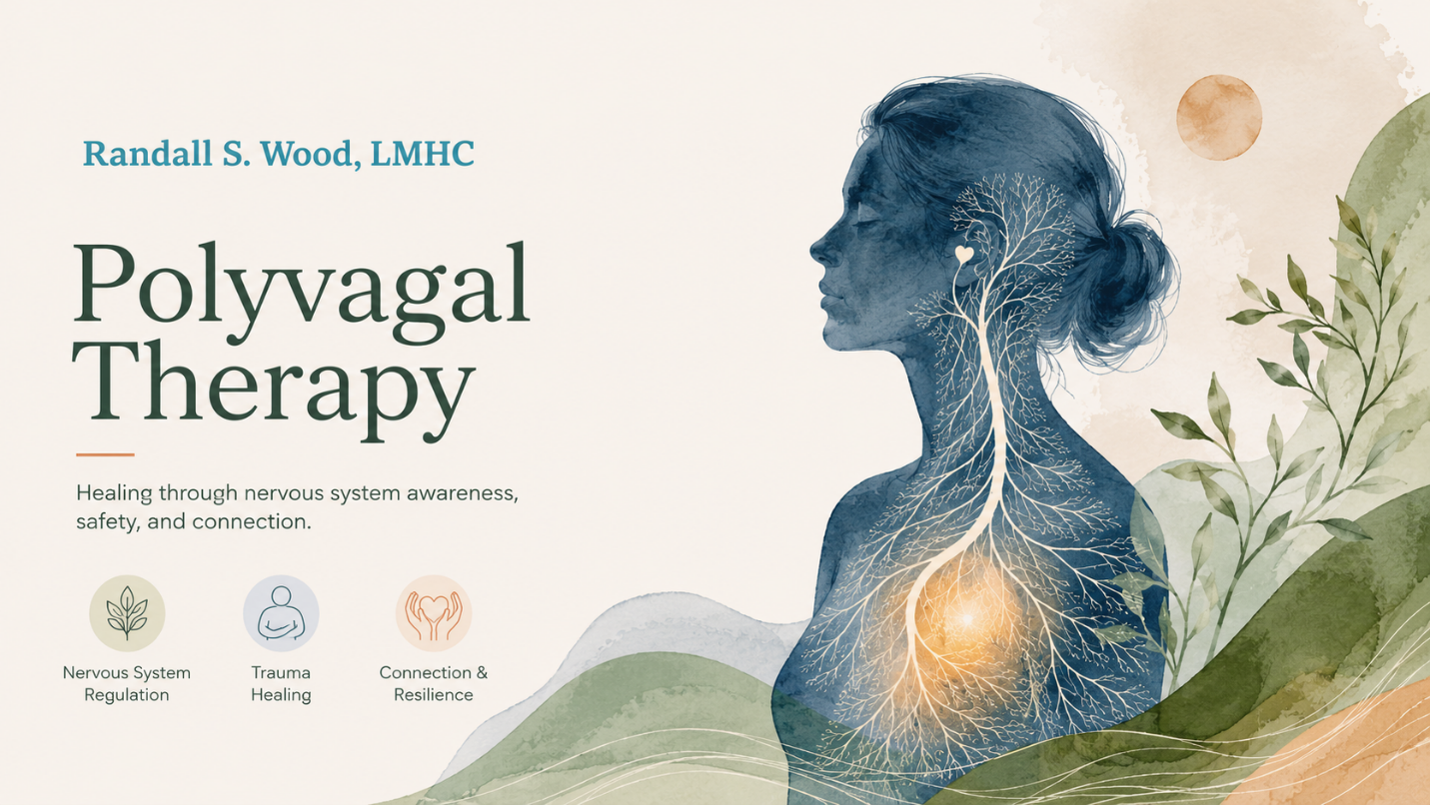
People often talk about stress as though it begins in the mind. The assumption is simple: if you could just think differently, organize better, or stay more positive, you would feel calmer. Yet most people know from experience that stress rarely works that way. You can understand a situation logically and still feel your heart racing. You can tell yourself you’re safe and still feel tense, guarded, or exhausted. That’s because stress is not only a psychological experience. It’s a physiological one.
This is one of the foundational ideas of Polyvagal Theory in Crawfordsville. Rather than a purely mental event, polyvagal theory helps explain how the nervous system informs how we experience safety, connection, and threat. At Randall S. Wood, LMHC, I often find this perspective to be a relief to clients. Many have spent years blaming themselves for reactions that make far more sense when viewed through the lens of the nervous system.
The Nervous System Is Always Listening
Most people are familiar with the sensation of entering a room and immediately understanding if the mood is relaxed or tense. And that reaction typically comes before the conscious thought gets in the way. The nervous system is constantly gathering information and making snap decisions about safety. When things are safe, people are often more present, flexible, and connected. They can hear better, think better, and connect with other people better. That protection can be of many kinds. Some people get anxious and hyper-vigilant. Some get irritable or defensive. Some withdraw completely, feeling numb or cut off from themselves and others.
Through Polyvagal Theory in Crawfordsville, clients begin to understand that these reactions are not character flaws. They are nervous system responses. That distinction matters because people tend to approach themselves differently once they understand what is actually happening.
Emotional Regulation Is Not Emotional Control
One misconception I encounter frequently is the belief that emotional regulation means suppressing emotions or staying calm at all costs. In reality, emotional regulation has very little to do with forcing emotions away. It’s about recognizing what is happening internally and responding with awareness instead of reacting automatically. At Randall S. Wood, LMHC, I help clients develop that awareness through counseling in Lafayette, Indiana. Often, the first step is simply learning to notice early signs of stress before they become overwhelming. Maybe it’s tension in the shoulders. A racing mind. The sudden urge to avoid a conversation. Small signals like these often appear long before a person realizes they’re becoming dysregulated.
Why Safety Matters More Than Most People Realize
One of the most practical lessons from Polyvagal Theory in Crawfordsville is that lasting change rarely happens when the nervous system feels threatened. People tend to think healing comes from pushing harder, trying harder, or forcing themselves through discomfort. Sometimes that approach works briefly. More often, it creates additional stress. That’s true in relationships, and it’s equally true in therapy. In my approach to counseling in Lafayette, Indiana, creating emotional safety isn’t a secondary goal. It’s the base that makes deeper work possible. When clients feel understood and not judged, they are more willing to explore difficult emotions, old patterns, and experiences they have been avoiding for years.
Without this foundation, therapy can become yet another setting in which people are forced to perform rather than to connect in authentic ways.
Improving Awareness in Daily Life
The relevance of this work goes well beyond the therapy office. Understanding the responses of the nervous system can help communication, improve relationships, and help to reduce the sense of confusion many people feel around their emotional responses.
Through counseling in Lafayette, Indiana, I help clients identify how stress affects their ability to relate to partners, family members, and co-workers. The more you become aware, the easier it becomes to notice and break these automatic responses. That doesn’t mean stress disappears. Life remains complicated. Relationships remain imperfect. But people often become far better at navigating those realities without feeling controlled by them.
Final Take
Stress makes more sense when viewed through the nervous system rather than through self-criticism. That’s one of the most valuable insights offered by Polyvagal Theory in Crawfordsville. At Randall S. Wood, LMHC, I use this framework alongside counseling in Lafayette, Indiana, to help clients better understand their emotional responses, relationship patterns, and experiences of stress. When people learn how their nervous system operates, they often stop seeing themselves as the problem.
And from my perspective, that’s where meaningful emotional regulation begins, not with control, but with understanding.
FAQs
- What is Polyvagal Theory in Crawfordsville?
Polyvagal Theory in Crawfordsville helps explain how the nervous system influences stress responses, emotional regulation, safety, and connection.
- How does Polyvagal Theory in Crawfordsville support emotional regulation?
It helps individuals recognize nervous system states, improving awareness of stress reactions and supporting healthier emotional responses daily.
- What can counseling in Lafayette, Indiana help with?
Counseling in Lafayette, Indiana, helps address anxiety, trauma, relationship challenges, emotional regulation difficulties, and ongoing life stressors.
- Why is emotional safety important during therapy?
Emotional safety allows clients to explore difficult experiences openly, build trust, and engage more effectively in therapy.
- How does Randall S. Wood, LMHC, incorporate polyvagal theory?
Randall S. Wood, LMHC, uses polyvagal theory principles to help clients understand stress, connection, and nervous system responses.